Herring-Hall-Marvin Safes
History and Restoration
Herring-Hall-Marvin didn’t start as one company — it started as three of the most respected names in 19th-century safe manufacturing, combined into one. In May 1892, Hall’s Safe & Lock Company of Cincinnati — founded by Joseph L. Hall in 1867 and, by the time of the merger, responsible for roughly half of all fireproof and burglar-proof safes produced in the United States — sold its business, trademarks, and goodwill into a newly formed New Jersey corporation alongside the Marvin Safe Company of New York and the Herring Safe Company.
The result was the Herring-Hall-Marvin Safe Company, a firm built from the combined engineering pedigree of all three predecessors.
The Marvin Safe Company traced its roots back to Azor S. Marvin’s 1840s work with the earliest fire-resistant “Salamander” safe patents. The Herring Safe Company, founded by Silas C. Herring, had been producing fireproof safes since the 1840s as well and was known for pioneering layered fireproof insulation using plaster and cement.
Hall’s Safe & Lock, for its part, had introduced early time lock technology in the 1870s and built a reputation as the largest safe and vault manufacturer in the world by the time of the merger. HHM inherited all of it.
A door still mounted in a working or former bank vault often has to be restored largely in place, since removing and transporting it isn’t practical or, in some cases, possible. A door being repurposed for a private installation — a home, a business, a themed space — can sometimes be removed and brought to our shop, which gives us more control over plating, painting, and mechanism work.
Either way, the same underlying process applies: full documentation, careful disassembly of the boltwork, plating and refinishing, and precision reassembly, the same approach we walk through on our restoration process page.
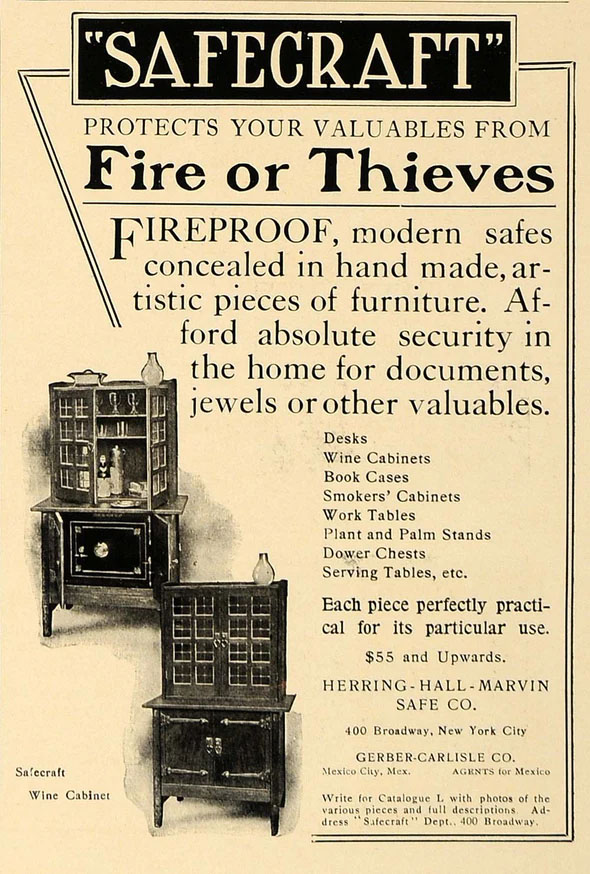
They were serving banks, businesses, and institutions through both World Wars and the Great Depression, before the company was eventually acquired by Diebold, Inc. in the mid-20th century
It brought its lineage full circle into one of the other major names in the industry (see our Diebold history and restoration page).
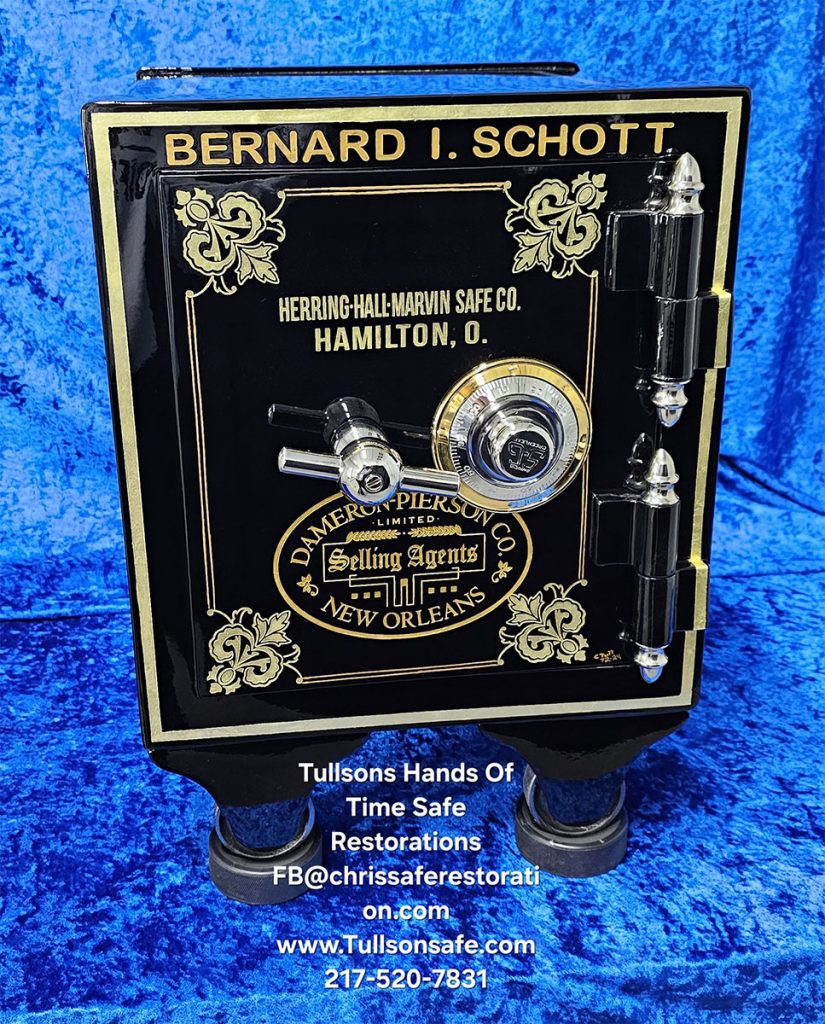
One of our full restorations involved an HHM safe that arrived in dire condition — rusted, with a seized locking mechanism and faded branding after decades of service. As with most HHM pieces, the exterior color wasn’t what it appeared to be: Japanning, a thick lacquer finish common to the era, had darkened and distorted the original coloring over time.
After documenting the safe’s condition, we stripped the corrosion, replated the boltwork, and restored the exterior to its true original finish before reassembling and testing the lock and time-lock mechanisms. You can see the full process breakdown on our restoration process page.
If you’re not certain whether your safe is HHM, a predecessor company, or something else entirely, contact us for more information.