National Safe & Lock Co.

History and Restoration

Not every 19th-century safe maker left behind the kind of extensive paper trail that companies like Mosler and Diebold did, and National Safe & Lock Co. is one of the better examples of that. Based in Cleveland, Ohio, the company operated from roughly the mid-1880s into the early 1920s, producing fireproof and burglar-resistant floor safes and bank safes that were sold through dealers around the country — including, in the piece we’ve documented from our own archive, through Norris & Co. of Chicago, whose advertising promised safes that were “hard-tried and every way reliable” for banks, offices, and stores.
Much of what’s known about National Safe & Lock Co. today comes from the safes themselves rather than from corporate records.

This isn’t unusual for smaller regional manufacturers of the era — we’ve encountered the same gap in documentation with other period makers, where surviving safes, dealer advertisements, and collector research fill in the picture far more than any surviving company archive does. 

Surviving National safes generally show the same design language common across the industry at the time: stepped, tapered doors, decorative gold-leaf lettering and pinstriping, and multi-bolt locking systems, including examples in the round “Cannonball” style that several manufacturers of the period produced.
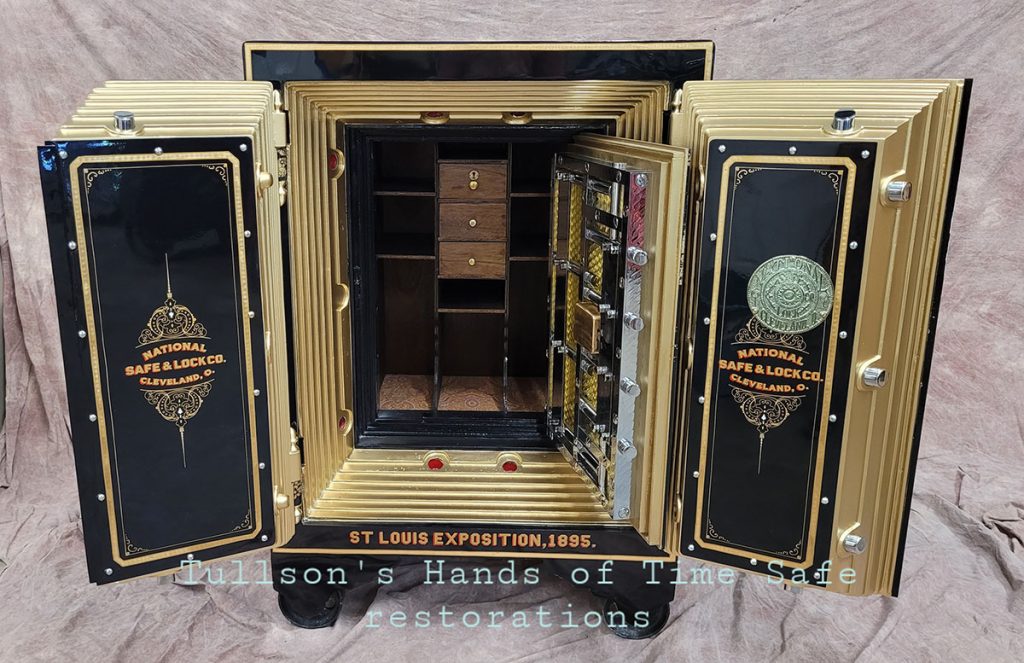
We’ve restored National Safe & Lock Co. pieces ourselves.

This includes a National Cannonball safe brought back to full function and finish — original mechanisms cleaned and serviced, plating restored, and decorative work recreated to match what survived on the piece itself. The restoration process we follow for a National safe is the same one we use across manufacturers: full documentation before anything is touched, careful disassembly and plating, color-accurate refinishing, and hand-recreated artwork.

If you have a safe with a National Safe & Lock Co. badge or dial and aren’t sure what you’re working with, contact us — between the maker’s mark, construction style, and surviving hardware, we can usually tell you what you have and roughly how old it is.

Want learn more? Check out these articles below.

How Antique Safes Survived the Great Chicago Fire

How to Identify Your Antique Safe's Manufacturer

Antique Time Lock Repair & Restoration

Scroll to Top