Mosler Safe History
Looking back at the history and restoration of Mosler safes.
Few names in the safe industry carry as much weight as Mosler. Founded in 1867 in Cincinnati by Gustave Mosler and Fred Bahmann as Mosler, Bahmann & Company, the business split in 1874 after Gustave Mosler’s death, and his family broke away to found the Mosler Safe & Lock Company.
By 1891, the company had outgrown its Cincinnati facilities, and several cities — Hamilton, Ohio among them — competed to land the relocation with financial incentives and worker housing. Hamilton won, and the town went on to be known as the “Safe Capital of the World” for much of the century that followed.
The company built the vault doors for the United States gold depository at Fort Knox, Kentucky — a fact the company was still proudly advertising decades later, describing itself as “Builders of the Famous U.S. Government Vault Doors at Fort Knox.”
During World War II, Mosler earned the Army-Navy “E” Award for excellence in war production multiple times, a distinction shared by only a small number of American manufacturers, and turned part of its Hamilton factory over to producing components for cyclotron magnets as part of the era’s military-industrial effort.
After the atomic bombing in 1945, one of the only structures left standing in the blast zone was the Teikoku Bank — and inside it, a vault built by Mosler. The discovery led the U.S. military to contract with Mosler for further testing, including exposing specially built vaults to actual nuclear blast conditions during Operation Plumbbob in the 1950s, to evaluate how well their designs held up under extreme conditions most manufacturers never had to consider.
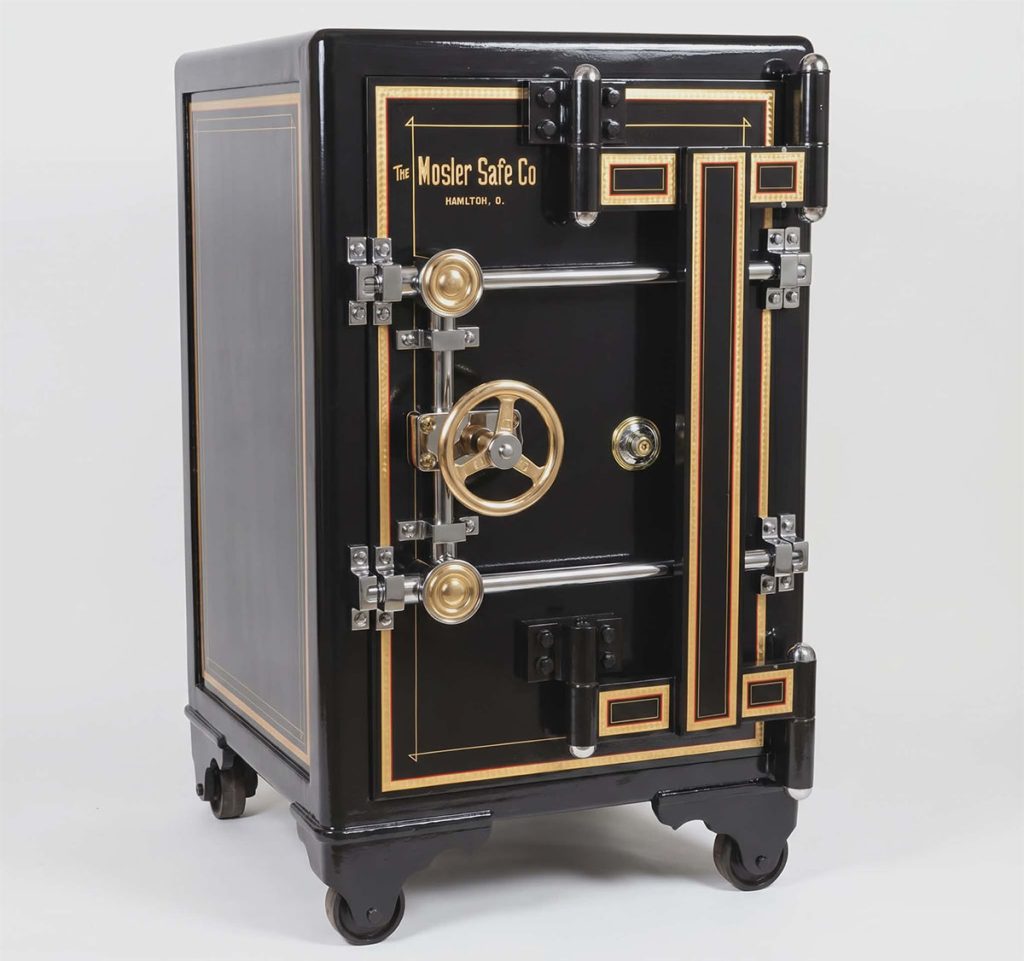
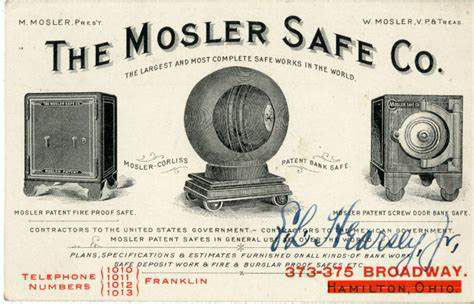
Mosler produced a range of styles over its history, from ornate hand-painted bank safes to the distinctive round-door “Cannonball” safes prized by collectors today, along with the heavy screw-door bank safes and fireproof designs the company advertised extensively in its own era.
Whether it’s a compact office safe or a full vault door with custom gold leaf and beveled glass, the boltwork, plating, and decorative finish process follows the same restoration approach outlined on our antique safe restoration process page — including projects we’ve completed with 18-, 23-, and 24-karat gold detailing and custom bulletproof glass on Mosler vault doors.
If you’re trying to confirm whether your safe is actually a Mosler, feel free to contact us for help.